
We have learned something really important from the way that the press sometimes describes Radical Candor as brutal honesty. And we want your advice on how to communicate this idea more clearly.
We want to learn to describe Radical Candor in a way that is not open to misinterpretation: too often press articles assert that Radical Candor is the same thing as brutal honesty, as front-stabbing, or that it is some sort of license to be a jerk. It is none of those things!
Need help implementing Radical Candor? Let's talk!
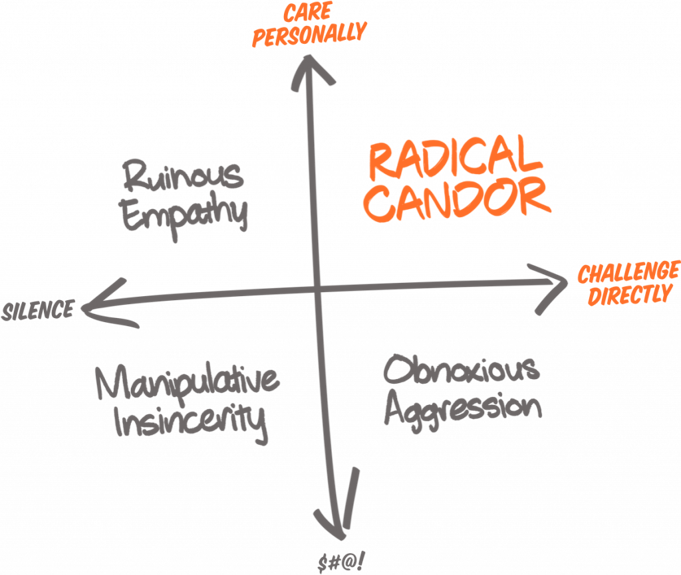
What is brutal honesty? Well, too often, Radical Candor gets illustrated with cartoons of people who are clearly maniacal jerks (classic examples of brutal honesty). Every time something like that happens, all of us at Radical Candor feel a little sad for a moment.
But once we get over feeling sad, we realize that we are not communicating clearly enough, and this helps us improve.
Of course, it’s also true that people sometimes write what sells rather than what they actually think, or what they hear.
Follow these 4 steps to create psychological safety in your teams >>
But, in the spirit of listening with the intent to understand rather than to respond, we would like to figure out how we can communicate more clearly rather than to complain about clickbait!
There’s no reason why an accurate representation can’t be as clickable as an inaccurate one.
In short, we need some Radical Candor on Radical Candor :)
Radical Candor is Caring Personally and Challenging Directly—
Radical Candor is Not Brutal Honesty
The whole point of Radical Candor is that it really is possible to Care Personally and Challenge Directly at the same time. The difference between brutal honesty vs. Radical Candor is caring personally about the people you are interacting with.
We CAN break free of a false dichotomy that leaves too many people feeling they have to choose between being a jerk and being incompetent.
That’s a terrible choice, and nobody has to make it. In fact, if you really care personally about somebody, you will tell them if you think they are making a mistake -- and when they are doing something great.
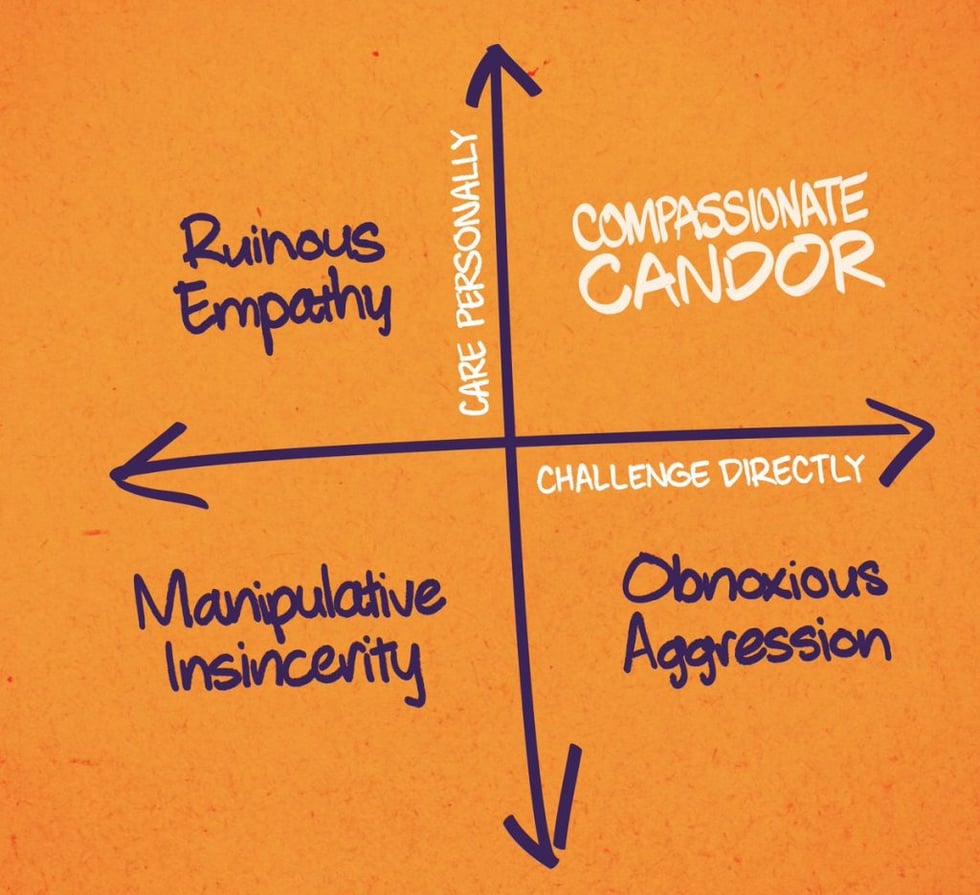
Radical Candor happens at the intersection of Care Personally and Challenge Directly. Care Personally means that you care about the other person, not about whether you are winning a popularity contest.
Challenge Directly means that you share your perspective and invite the other person to do the same.
There is a world of difference between Radical Candor and brutal honesty, or as we call it, Obnoxious Aggression. It’s bad, but Ruinous Empathy can be even worse, and Manipulative Insincerity is the worst of all.
- Radical Candor is kind and helpful.
- Obnoxious Aggression is mean but may be helpful. Obnoxious Aggression is also called “brutal honesty” or “front stabbing.”
- Ruinous Empathy is “nice” but ultimately unhelpful or even damaging. It’s seeing somebody with their fly down, but, not wanting to embarrass them, saying nothing, with the result that 15 more people see them with their fly down -- more embarrassing for them.
- Manipulative Insincerity is a stab in the back.
The whole point of Radical Candor is that it really is possible to Care Personally and Challenge Directly at the same time.

What Caring Personally is NOT
- Caring Personally does NOT mean getting all personal with somebody who wants privacy. I once worked with a man who had a terminal illness. Work was the only place where nobody had to know about that or ask about that. The best way I could Care Personally about this man was to protect his secret, and never once asked him about his health. We focused on the work.
- Caring Personally also does NOT mean over-sharing personal details of your life with those around you who may not want to hear them, and who may be made uncomfortable by them.
What Challenging Directly is NOT
- Challenging Directly does NOT mean you can assume that whatever you think is “the truth” and therefore should be shoved down people’s throats.
- Challenging Directly does NOT mean you are right. You may be wrong. In fact, you should expect and welcome a reciprocal challenge.
- The “direct” in “Challenge Directly” does NOT mean to be brutal. Radical Candor is not brutal honesty. It means to share your (humble) opinions directly, rather than talking badly about people behind their backs.
- Challenge Directly does NOT mean just saying whatever nutty thing pops into your head…

What Caring Personally IS
- Caring Personally is at its core common human decency. You don’t have to have a deeply personal relationship to have this as your point of departure. But if you work closely with somebody -- if for example, you are somebody’s boss -- you need to begin to develop a positive human relationship with that person.
- Caring Personally is inherently about thinking of others, putting their success and needs ahead of your own. At its best, it is not about being loved; it is about loving.
- To Care Personally, one must move at a pace that doesn’t make the other person uncomfortable. The fox in Saint-Exupéry’s The Little Prince described what I’m talking about most beautifully. You can read the scene here.
What Challenging Directly IS
- Challenging Directly is giving people the kind of heads-up that underlies basic human decency. Imagine that you were working on a construction site and you looked up and saw a man cutting an iron beam -- but sitting on the wrong end. When he finishes cutting he will plummet eight stories to his death. Challenging Directly is sort of like saying, perhaps yelling even, “Hey, you’re on the wrong end of that beam, you’ll plunge to your death if you keep cutting!” Of course, you’d do that, and right away, right??
- But there is no reason that moving quickly has to mean moving disrespectfully. It’s not going to help the guy to preface your warning with a “Hey, dummy!” And, it could be that you don’t understand what he’s doing, and he’s actually not about to plummet to his death... Challenging Directly is first and foremost humble.
- It’s tempting to say that “Caring Personally” is about love, and Challenging Directly is about truth. But there is a problem with the word “truth...” This gets me to why we call it Radical Candor, not “brutal honesty.”
Why It’s Called “Candor”
We chose the word candor over truth or honesty very consciously.
There is nothing humble about the Truth. There was a Jesuit missionary a colleague of mine met in the Congo in the early '60s.
It’s important always to tell the truth.” The missionary then looked heavenward. “But who knows what the truth is?”
I always think of this Jesuit when somebody says to me, “I’m going to tell you the truth.” How are you so sure you know what the truth is? Are you sure I don’t have a clearer idea of the truth??
We chose the word candor because, to us, the word has more of a “here’s what I think, what do you think” connotation than the words “truth” or “honesty” do.
Why It’s Called “Radical”
Why did we choose the word “radical?” Here’s a definition of radical: “(especially of change or action) relating to or affecting the fundamental nature of something; far-reaching or thorough.”
The reason we use the word Radical is that the kind of compassionate candor we’re talking about is rare. It feels unnatural to practice it. It flies in the face of the “if you don’t have anything nice to say don’t say it at all” maxim that most of us have heard since we learned to talk. Changing training that’s been instilled in us since we were eighteen months old is hard.
Often when we started sharing early versions of the candor materials with people, they called what we were talking about “brutal honesty” or “tough love.” Words like “brutal” and “tough” indicated it was OK to be a jerk.
But we are trying to rid the world of bad bosses, and so we are second to none in our adherence to the No Asshole Rule! So we don’t like those terms.
I had the opportunity to present this linguistic challenge -- how to describe in two words communication that is fundamentally kind even though it’s natural to worry it might be interpreted as “mean” -- to Dan Pink.
Dan has a genius for communicating big ideas in a couple of words. We were riding together in an elevator, and somewhere between the lobby and the fifth floor, Dan Pink exclaimed, “Radical Candor! I would read a book called Radical Candor!”
We need your help -- some Radical Candor on Radical Candor, please!
It’s important to clarify that Radical Candor is not “brutal honesty.” It is not “front-stabbing.” Radical Candor means Challenging Directly while also showing that you Care Personally. We are not sure why cartoonists keep illustrating it with some maniac yelling at others. That’s certainly not what we are trying to say!
How can we convey this message more clearly? We’d love to hear your thoughts -- or see your drawings!
Contact us >>
—————————————————————————————————————————
*This post was updated March 1, 2020.
More from Radical Candor
How Do You Ask for Feedback? The Three Tests of a Good Go-To Question
The idea Get it. Don’t just be open to it.
How Do You Get Feedback? The Four Steps to Solicit Radical Candor®
A Story People often focus on feedback they get from their bosses. But the best feedback comes from the people who work for you. It can be difficult to get it—unless you create a …
Fixing the Employee Experience (with Tiffani Bova) 8 | 26
While the podcast team is on a Radical Sabbatical, Kim Scott is spending the season talking to authors of the books that have shaped her thinking. This week: Tiffani Bova, whose …
Share your perspective
This site is protected by reCAPTCHA and the Google Privacy Policy and Terms of Service apply.